
What Is De-Shedding Treatment for Dogs — and Does It Actually Work?
By Kristine — Professional dog groomer, former show dog KK Dog Grooming handler, and Bernese Mountain Dog breeder. Owner of KK Dog Grooming, 30 Wharfside, Bletchley, Milton Keynes MK2 2AZ. | 07415 505151
If your sofa looks like it belongs to the dog rather than you, and you find hair on every piece of clothing before you even leave the house, your dog is almost certainly carrying a thick trapped undercoat that regular brushing barely touches.
Dog de-shedding treatment is the professional solution to this problem. It removes the loose, dead undercoat that causes most of the household shedding — and the difference owners notice afterwards is usually immediate and significant. But there is also a lot of misinformation out there about shedding, particularly around shaving as a solution. So here is the straight explanation of what de-shedding treatment does, which dogs actually need it, and what to avoid.
Understanding Why Dogs Shed So Much
Dogs with double coats carry two distinct layers of fur. The outer coat — called the guard coat — consists of longer, coarser hairs that protect the skin from sun, cold, thorns, and moisture. Beneath it sits the undercoat: a dense, soft layer of shorter hairs that provides insulation.
The undercoat sheds continuously throughout the year, with two heavy seasonal shedding events in spring and autumn when the whole undercoat blows out to make way for the next season's growth. This is entirely natural — but in a domestic setting, that shed undercoat has nowhere to go except your furniture, your car, your clothes, and your carpet.
Regular brushing removes some of it. But a standard brush only reaches the surface layer. The deeply trapped undercoat — the layer sitting close to the skin — does not come out with a slicker brush alone. That is where professional de-shedding treatment comes in.
What De-Shedding Treatment Actually Does
Professional de-shedding treatment works in two stages.
First, a specialist de-shedding shampoo and conditioning treatment is worked through the coat during the bath. These products are specifically formulated to loosen the bond between the loose undercoat hairs and the skin, making extraction far more effective than a standard wash.
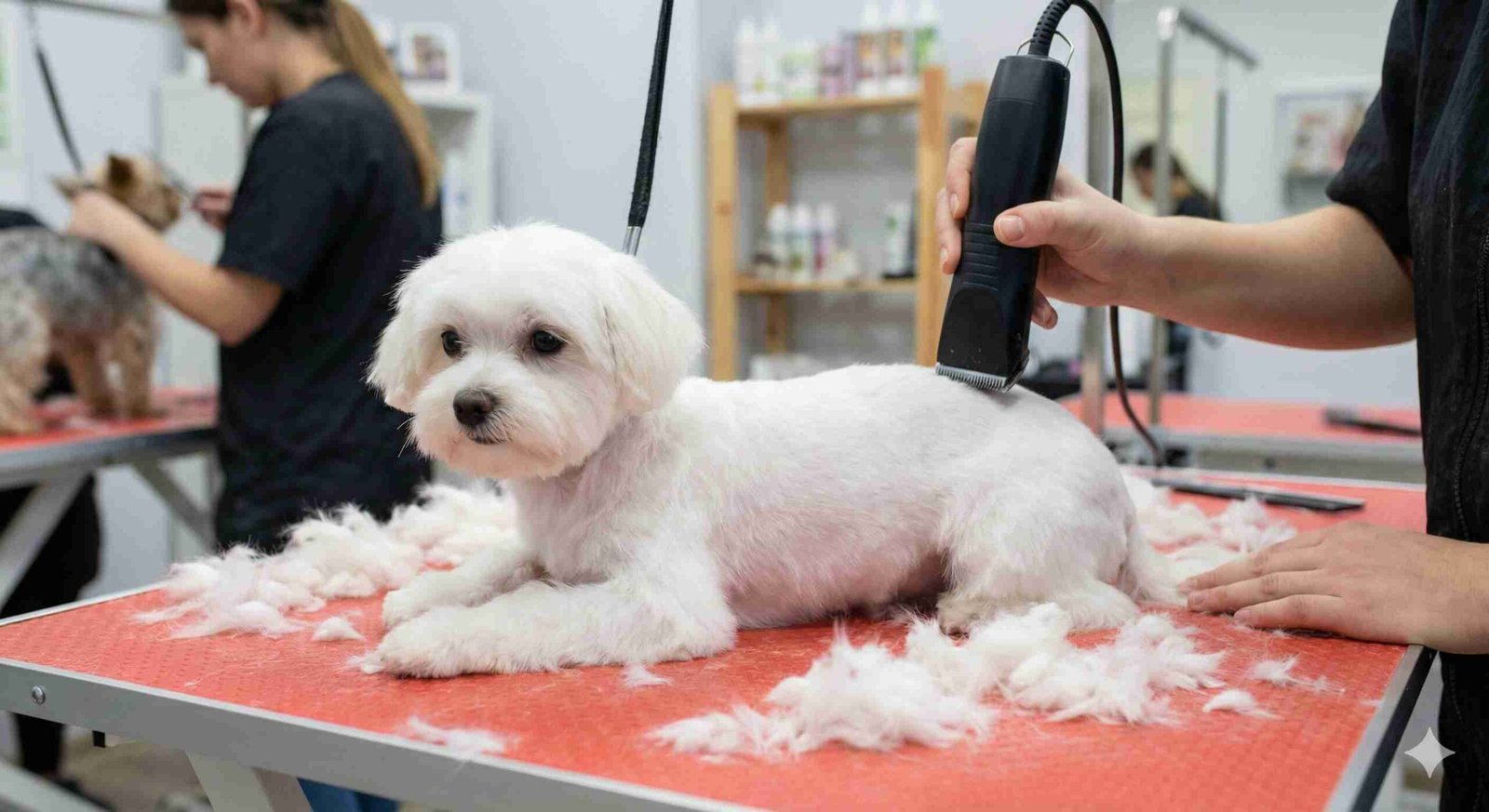
Second — and this is the stage that makes the biggest visible difference — a high-velocity blow dryer is used after the bath to push the loosened undercoat out from the roots. You can actually see the hair coming out in clouds during this stage. What remains when it is finished is the guard coat, intact and healthy, with the loose shed undercoat largely removed.
The final step is a thorough brush through to remove any remaining loose hair. By the end of the appointment, most double-coated dogs have lost a significant quantity of dead undercoat that would otherwise have shed gradually at home over the following weeks.
Which Dogs Benefit Most From De-Shedding Treatment
De-shedding treatment is specifically designed for dogs with a dense undercoat. The breeds that benefit most are the ones owners typically find most challenging to manage in terms of household shedding.
→ Labradors and Golden Retrievers — two of the most common breeds in Milton Keynes and two of the heaviest shedders. Their dense double coats blow out heavily twice a year.
→ German Shepherds — known for almost continuous shedding, with dramatic seasonal blowouts. De-shedding treatment makes a very visible difference for these dogs.
→ Huskies and Malamutes — the most extreme undercoat volume of any breed. Seasonal shedding in spring can be genuinely overwhelming without professional treatment.
→ Bernese Mountain Dogs — a breed I know particularly well from my breeding background. Gorgeous coats, but significant year-round shedding with a heavy seasonal component.
→ Border Collies and Australian Shepherds — working dog coats that shed consistently and benefit greatly from regular treatment.
— plush double coats that mat and shed heavily without regular professional care.
Short-coated breeds like Pugs, French Bulldogs, and Beagles also shed more than owners expect. A de-shedding shampoo adds to their standard bath appointment and reduces the fine, prickly hair that embeds in fabric.
Why Shaving Is Never the Answer for Double-Coated Dogs
This is one of the most common mistakes I see — and unfortunately it is one that causes lasting damage to the coat.
The logic seems to make sense: if the coat causes shedding, removing the coat stops shedding. But shaving a double-coated dog does not work that way. The undercoat continues to grow regardless of whether the guard coat is present or not. So after shaving, the dog still sheds — it just sheds shorter hairs rather than longer ones, and those shorter hairs actually embed more easily in fabric.
Far more seriously, shaving removes the guard coat that provides UV protection and temperature regulation. A double-coated dog does not get cooler when shaved — the coat actually insulates against heat as well as cold. Without the guard coat, the dog is exposed to sunburn and overheating in ways the breed was never designed to handle.
Worst of all, in many breeds the guard coat does not grow back correctly after shaving. The condition is called post-clipping alopecia — the coat grows back with a different texture, comes in patchy, or in some cases barely grows back at all. I have seen this in Huskies, Chow Chows, and Samoyeds who were shaved by owners who thought it would help in summer. The results are genuinely distressing and in some cases irreversible.
How Often Should You Book De-Shedding Treatment?
Most double-coated dogs benefit from de-shedding treatment every 6 to 8 weeks alongside their regular groom.
During the two heavy shedding seasons — typically March to May in spring, and September to November in autumn — booking more frequently, every 4 to 6 weeks, keeps the household shedding under control during the peak blowout period.
The frequency that suits your dog depends on how heavily they shed and how bothered you are by household hair.
Some owners of very heavy shedders book monthly during spring and autumn and every 6 to 8 weeks for the rest of the year.
What to Expect After a De-Shedding Treatment
The results are most dramatic in the first few days after the appointment. Many owners tell me their dog barely sheds at all in the week following treatment — which feels almost surreal if they are used to daily hoovering.
Over the following weeks, shedding gradually returns as new undercoat grows in. By week 5 or 6, most dogs are back to their normal shedding level and ready for their next treatment. The cycle of treatment keeps the total amount of loose undercoat present in the coat significantly lower than without treatment — so even between appointments, shedding tends to be less than it was before the owner started regular professional de-shedding sessions.
A final note: your dog may look slightly fluffier immediately after the appointment, since the high-velocity blow dry opens the coat up considerably. This settles within a day or two as the coat lies back down naturally.
Frequently Asked Questions
It removes the loose trapped undercoat using specialist shampoo and a high-velocity blow dry. The result is significantly less shedding at home for several weeks afterwards.
Double-coated breeds shed the most: Labradors, Golden Retrievers, German Shepherds, Huskies, Border Collies, Akitas, Chow Chows, Bernese Mountain Dogs, and Samoyeds. Short-coated heavy shedders like Pugs and French Bulldogs also benefit.
£5 for XS and small dogs, £7 for medium dogs, £10 for large dogs. Added to a bath or full groom appointment at KK Dog Grooming in Bletchley, Milton Keynes.
Book Your Puppy's First Grooming Session in Bletchley
KK Dog Grooming is at 30 Wharfside, Fenny Stratford, Bletchley, Milton Keynes MK2 2AZ, open Monday to Friday, 10:00–18:00. Call or WhatsApp Kristine on 07415 505151, or email kkpetstyling@gmail.com.
Not sure if your puppy is ready? Call for a quick chat first. Kristine is happy to discuss your puppy's age, breed, and temperament to confirm the right timing before you book. You can also read more about what the session involves on the Puppy Introduction Service page, or see all available services on the services page.
Do not wait until your puppy is 6 months old to think about grooming. The window to build easy, stress-free grooming habits is open right now and getting in touch takes less than a minute.